
-
Low-touch onboarding of NetScaler instances using Console Advisory Connect
-
-
Importing and synchronizing StyleBooks from an external repository
-
Create and use custom StyleBooks
-
Create a StyleBook to upload files to NetScaler Console service
-
Create a StyleBook to upload SSL certificate and certificate key files to NetScaler Console service
-
Enable analytics and configure alarms on a virtual server defined in a StyleBook
-
Allow special characters with their literal form in StyleBooks
-
Use API to create configurations from StyleBooks
-
This content has been machine translated dynamically.
Dieser Inhalt ist eine maschinelle Übersetzung, die dynamisch erstellt wurde. (Haftungsausschluss)
Cet article a été traduit automatiquement de manière dynamique. (Clause de non responsabilité)
Este artículo lo ha traducido una máquina de forma dinámica. (Aviso legal)
此内容已经过机器动态翻译。 放弃
このコンテンツは動的に機械翻訳されています。免責事項
이 콘텐츠는 동적으로 기계 번역되었습니다. 책임 부인
Este texto foi traduzido automaticamente. (Aviso legal)
Questo contenuto è stato tradotto dinamicamente con traduzione automatica.(Esclusione di responsabilità))
This article has been machine translated.
Dieser Artikel wurde maschinell übersetzt. (Haftungsausschluss)
Ce article a été traduit automatiquement. (Clause de non responsabilité)
Este artículo ha sido traducido automáticamente. (Aviso legal)
この記事は機械翻訳されています.免責事項
이 기사는 기계 번역되었습니다.책임 부인
Este artigo foi traduzido automaticamente.(Aviso legal)
这篇文章已经过机器翻译.放弃
Questo articolo è stato tradotto automaticamente.(Esclusione di responsabilità))
Translation failed!
Create or upload an API definition
An API definition is a document that describes an API using OpenAPI Specification standards. This definition can contain API resource paths and methods to operate them. You can add API definitions to NetScaler Console then deploy them to an API gateway (NetScaler).
You can create API definitions in one of the following ways:
Note:
Currently, NetScaler Console supports parsing OAS specification files that use Swagger 2.0 or openapi 3.0.1.
Upload the OAS specification
You can upload the OAS specification to the NetScaler Console GUI.
-
Navigate to Security > API Security > API Definitions.
-
Click Add.
-
Select Upload OAS Specification.
Note:
Ensure that the OAS Specification file is in YAML or JSON format. And, this file must not contain external references.
-
Browse an OAS specification from your local computer and upload to NetScaler Console.
Create an API definition
You can create your own API definition in the NetScaler Console GUI.
-
Navigate to Security > API Security > API Definitions.
-
Click Add.
-
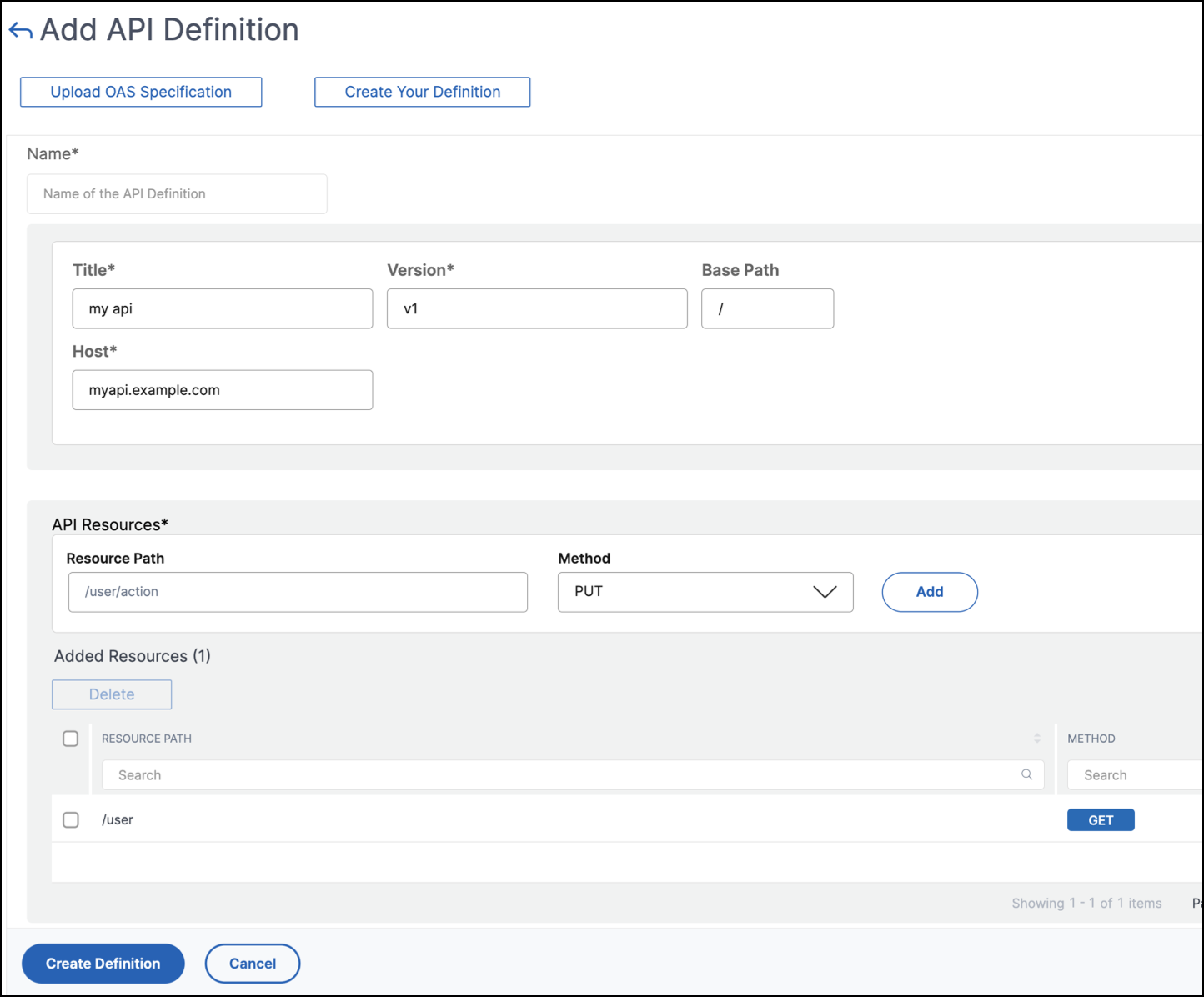
Select Create Your Definition and specify the following:
-
Name - A name for the API definition.
-
API Definition - A definition must include title, version, base path, and host. You can specify a domain name or IP address in the Host field.
-
API Resources - Add multiple API resources to your definition. Each resource has a path and supported method. Click Add. The resource is added to the Added Resources table. Click Delete to delete an API resource.
-
-
Click Create.
View API definitions
The API Definitions page lists the uploaded definition. Click View to see the following API definition details:
-
Name – Displays the name of an API definition.
-
API Definition – Displays title, version, base path, and host of a definition.
-
API resources – Lists the API resources in an API definition and their methods to operate them.
Share
Share
This Preview product documentation is Cloud Software Group Confidential.
You agree to hold this documentation confidential pursuant to the terms of your Cloud Software Group Beta/Tech Preview Agreement.
The development, release and timing of any features or functionality described in the Preview documentation remains at our sole discretion and are subject to change without notice or consultation.
The documentation is for informational purposes only and is not a commitment, promise or legal obligation to deliver any material, code or functionality and should not be relied upon in making Cloud Software Group product purchase decisions.
If you do not agree, select I DO NOT AGREE to exit.