-
Getting Started with NetScaler
-
Solutions for Telecom Service Providers
-
Load Balance Control-Plane Traffic that is based on Diameter, SIP, and SMPP Protocols
-
Provide Subscriber Load Distribution Using GSLB Across Core-Networks of a Telecom Service Provider
-
Authentication, authorization, and auditing application traffic
-
Basic components of authentication, authorization, and auditing configuration
-
Web Application Firewall protection for VPN virtual servers and authentication virtual servers
-
On-premises NetScaler Gateway as an identity provider to Citrix Cloud™
-
Authentication, authorization, and auditing configuration for commonly used protocols
-
Troubleshoot authentication and authorization related issues
-
Troubleshoot authentication, authorization and auditing issues
-
Configure EULA as an authentication factor in NetScaler nFactor system
-
Configure periodic Endpoint Analysis scan as a factor in nFactor authentication
-
Configure post-authentication Endpoint Analysis scan as a factor in NetScaler nFactor authentication
-
Configure pre-authentication Endpoint Analysis scan as a factor in nFactor authentication
-
Configure pre-auth and post-auth EPA scan as a factor in nFactor authentication
-
Configure prefill user name from certificate in NetScaler nFactor authentication
-
Localize error messages generated by NetScaler nFactor system
-
Configure NetScaler Gateway preauthentication EPA scan for the domain check
-
-
-
-
-
-
Persistence and persistent connections
-
Advanced load balancing settings
-
Gradually stepping up the load on a new service with virtual server–level slow start
-
Protect applications on protected servers against traffic surges
-
Retrieve location details from user IP address using geolocation database
-
Use source IP address of the client when connecting to the server
-
Use client source IP address for backend communication in a v4-v6 load balancing configuration
-
Set a limit on number of requests per connection to the server
-
Configure automatic state transition based on percentage health of bound services
-
-
Use case 2: Configure rule based persistence based on a name-value pair in a TCP byte stream
-
Use case 3: Configure load balancing in direct server return mode
-
Use case 6: Configure load balancing in DSR mode for IPv6 networks by using the TOS field
-
Use case 7: Configure load balancing in DSR mode by using IP Over IP
-
Use case 10: Load balancing of intrusion detection system servers
-
Use case 11: Isolating network traffic using listen policies
-
Use case 12: Configure Citrix Virtual Desktops for load balancing
-
Use case 13: Configure Citrix Virtual Apps and Desktops for load balancing
-
Use case 14: ShareFile wizard for load balancing Citrix ShareFile
-
Use case 15: Configure layer 4 load balancing on the NetScaler appliance
-
-
-
TLSv1.3 protocol support as defined in RFC 8446
-
-
Create a certificate signing request and use SSL certificates on a NetScaler appliance
-
Configure SSL acceleration with HTTP on the front end and SSL on the back end
-
Export certificates used on a NetScaler appliance as PFX file
-
Configure SSL monitoring when client authentication is enabled on the back-end service
-
Configure SSL action to forward client traffic if a cipher is not supported on the ADC
-
Configure synchronization of files in a high availability setup
-
-
-
Authentication and authorization for System Users
-
-
Configuring a CloudBridge Connector Tunnel between two Datacenters
-
Configuring CloudBridge Connector between Datacenter and AWS Cloud
-
Configuring a CloudBridge Connector Tunnel Between a Datacenter and Azure Cloud
-
Configuring CloudBridge Connector Tunnel between Datacenter and SoftLayer Enterprise Cloud
-
Configuring a CloudBridge Connector Tunnel Between a NetScaler Appliance and Cisco IOS Device
-
CloudBridge Connector Tunnel Diagnostics and Troubleshooting
This content has been machine translated dynamically.
Dieser Inhalt ist eine maschinelle Übersetzung, die dynamisch erstellt wurde. (Haftungsausschluss)
Cet article a été traduit automatiquement de manière dynamique. (Clause de non responsabilité)
Este artículo lo ha traducido una máquina de forma dinámica. (Aviso legal)
此内容已经过机器动态翻译。 放弃
このコンテンツは動的に機械翻訳されています。免責事項
이 콘텐츠는 동적으로 기계 번역되었습니다. 책임 부인
Este texto foi traduzido automaticamente. (Aviso legal)
Questo contenuto è stato tradotto dinamicamente con traduzione automatica.(Esclusione di responsabilità))
This article has been machine translated.
Dieser Artikel wurde maschinell übersetzt. (Haftungsausschluss)
Ce article a été traduit automatiquement. (Clause de non responsabilité)
Este artículo ha sido traducido automáticamente. (Aviso legal)
この記事は機械翻訳されています.免責事項
이 기사는 기계 번역되었습니다.책임 부인
Este artigo foi traduzido automaticamente.(Aviso legal)
这篇文章已经过机器翻译.放弃
Questo articolo è stato tradotto automaticamente.(Esclusione di responsabilità))
Translation failed!
TLSv1.3 protocol support as defined in RFC 8446
The NetScaler VPX and NetScaler MPX appliances now support the TLSv1.3 protocol, specified in RFC 8446.
Notes:
From release 13.0 build 71.x and later, TLS1.3 hardware acceleration is supported on the following platforms:
- MPX 5900
- MPX/SDX 8900
- MPX/SDX 9100
- MPX/SDX 9200
- MPX/SDX 15000
- MPX/SDX 15000-50G
- MPX/SDX 16000
- MPX/SDX 17000
- MPX/SDX 26000
- MPX/SDX 26000-50S
- MPX/SDX 26000-100G
TLSv1.3 is only supported with the enhanced profile. To enable the enhanced profile, see Enable the default profile.
To use TLS1.3, you must use a client that conforms to the RFC 8446 specification.
Supported NetScaler features
The following SSL features are supported:
- TLSv1.3 cipher suites:
- TLS1.3-AES256-GCM-SHA384 (0x1302)
- TLS1.3_CHACHA20_POLY1305_SHA256 (0x1303)
- TLS1.3-AES128_GCM-SHA256 (0x1301)
- ECC curves for ephemeral Diffie-Hellman key exchange:
- P_256
- P_384
- P_521
-
Abbreviated handshakes when ticket-based session resumption is enabled
-
0-RTT early application data
-
Optional or mandatory certificate-based client authentication, with support for OCSP and CRL validation of client certificates
-
Server name extension: server certificate selection by using SNI
-
Application protocol negotiation (ALPN) by using the application_level_protocol_negotiation extension.
-
OCSP stapling
-
Log messages and AppFlow records are produced for TLSv1.3 handshakes.
-
Optional logging of TLS 1.3 traffic secrets by the
nstracepacket capture utility. - Interoperability with TLS clients implementing RFC 8446. For example, Mozilla Firefox, Google Chrome, and OpenSSL.
Supported browsers
The following browser versions are supported and compatible with the NetScaler implementation oF TLS 1.3 protocol:
- Google Chrome - Version 72.0.3626.121 (Official Build) (64-bit)
- Mozilla Firefox - 65.0.2 (64-bit)
- Opera - Version:58.0.3135.79
Configuration
TLSv1.3 is disabled by default on an SSL profile.
Add an SSL profile by using the CLI
At the command prompt, type:
add ssl profile <tls13-profile-name>
<!--NeedCopy-->
Example:
add ssl profile tls13profile

sh ssl profile tls13profile
1)  Name: tls13profile           (Front-End)
    SSLv3: DISABLED               TLSv1.0: ENABLED  TLSv1.1: ENABLED  TLSv1.2: ENABLED  TLSv1.3: DISABLED
    Client Auth: DISABLED
    Use only bound CA certificates: DISABLED
    Strict CA checks:   NO
    Session Reuse: ENABLED                       Timeout: 120 seconds
    DH: DISABLED
    DH Private-Key Exponent Size Limit: DISABLED   Ephemeral RSA: ENABLED                            Refresh Count: 0
    Deny SSL Renegotiation                                ALL
    Non FIPS Ciphers: DISABLED
    Cipher Redirect: DISABLED
    SSL Redirect: DISABLED
    Send Close-Notify: YES
    Strict Sig-Digest Check: DISABLED
    Zero RTT Early Data: DISABLED
    DHE Key Exchange With PSK: NO
    Tickets Per Authentication Context: 1
    Push Encryption Trigger: Always
    PUSH encryption trigger timeout:             1 ms
    SNI: DISABLED
    OCSP Stapling: DISABLED
    Strict Host Header check for SNI enabled SSL sessions: NO
    Push flag:            0x0 (Auto)
    SSL quantum size:                            8 kB
    Encryption trigger timeout           100 mS
    Encryption trigger packet count:               45
    Subject/Issuer Name Insertion Format: Unicode

    SSL Interception: DISABLED
    SSL Interception OCSP Check: ENABLED
    SSL Interception End to End Renegotiation: ENABLED
    SSL Interception Maximum Reuse Sessions per Server:  10
    Session Ticket: DISABLED
    HSTS: DISABLED
    HSTS IncludeSubDomains: NO
    HSTS Max-Age: 0

    ECC Curve: P_256, P_384, P_224, P_521

1)  Cipher Name: DEFAULT Priority :1
    Description: Predefined Cipher Alias
Done
<!--NeedCopy-->
Add an SSL profile by using the GUI
- Navigate to System > Profiles. Select SSL Profiles.
- Click Add and specify a name for the profile.
-
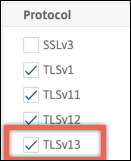
In Protocol, select TLSv13.
- Click OK.
Bind an SSL profile to an SSL virtual server by using the CLI
At the command prompt, type:
set ssl vserver <vServerName> -sslProfile <tls13-profile-name>
<!--NeedCopy-->
Example:
set ssl vserver ssl-vs -sslProfile tls13profile
Bind an SSL profile to an SSL virtual server by using the GUI
- Navigate to Traffic Management > Load Balancing > Virtual Servers, and select an SSL virtual server.
- In Advanced Settings, click SSL Profile.
- Select the TLSv1.3 profile created earlier.
- Click OK.
- Click Done.
SSL profile parameters for TLSv1.3 protocol
-
Enable or disable TLS1.3 parameters in an SSL profile.
tls13: State of TLSv1.3 protocol support for the SSL profile.
Possible values: ENABLED, DISABLED
Default value: DISABLED
set ssl profile tls13profile -tls13 enable
<!--NeedCopy-->
set ssl profile tls13profile -tls13 disable <!--NeedCopy--> -
Set the number of session tickets issued.
tls13SessionTicketsPerAuthContext: Number of tickets the SSL virtual server issues when TLS1.3 is negotiated, ticket-based resumption is enabled, and either (1) a handshake completes or (2) client authentication completes after the handshake.
This value can be increased to enable clients to open multiple parallel connections using a fresh ticket for each connection.
No tickets are sent if resumption is disabled.
Default value: 1
Minimum value: 1
Maximum value: 10
set ssl profile tls13profile -tls13sessionTicketsPerAuthContext 1 set ssl profile tls13profile -tls13sessionTicketsPerAuthContext 10 <!--NeedCopy--> -
Set DH key exchange
dheKeyExchangeWithPsk: Specifies whether an SSL virtual server requires a DHE key exchange to occur when a preshared key is accepted during a TLS 1.3 session resumption handshake. A DHE key exchange ensures forward secrecy, even if ticket keys are compromised, at the expense of extra resources required to carry out the DHE key exchange.Available settings work as follows, if the session ticket is enabled:
YES: DHE key exchange is required when a pre-shared key is accepted, regardless of whether the client supports the key exchange. The handshake is aborted with a fatal alert, if the client does not support DHE key exchange when offering a pre-shared key.
NO: DHE key exchange is performed when a pre-shared key is accepted, only if requested by the client.
Possible values: YES, NO
Default value: NO
set ssl profile tls13profile dheKeyExchangeWithPsk yes set ssl profile tls13profile dheKeyExchangeWithPsk no <!--NeedCopy--> -
Enable or disable 0-RTT early data acceptance
zeroRttEarlyData: State of TLS 1.3 early application data. Applicable settings work as follows:ENABLED: Early application data might be processed before the handshake is complete. DISABLED: Early application data is ignored.
Possible values: ENABLED, DISABLED
Default value: DISABLED
set ssl profile tls13profile -zeroRttEarlyData ENABLED

set ssl profile tls13profile -zeroRttEarlyData DISABLED
<!--NeedCopy-->
Default cipher group
The default cipher group includes TLS1.3 ciphers.
sh cipher DEFAULT
1) Cipher Name: TLS1-AES-256-CBC-SHA    Priority : 1
    Description: SSLv3 Kx=RSA      Au=RSA  Enc=AES(256)  Mac=SHA1   HexCode=0x0035

2)  Cipher Name: TLS1-AES-128-CBC-SHA    Priority : 2
    Description: SSLv3 Kx=RSA      Au=RSA  Enc=AES(128)  Mac=SHA1   HexCode=0x002f
…
…
27) Cipher Name: TLS1.3-AES256-GCM-SHA384         Priority : 27
    Description: TLSv1.3 Kx=any      Au=any  Enc=AES-GCM(256) Mac=AEAD   HexCode=0x1302

28) Cipher Name: TLS1.3_CHACHA20_POLY1305_SHA256     Priority : 28
    Description: TLSv1.3 Kx=any      Au=any  Enc=CHACHA20/POLY1305(256) Mac=AEAD   HexCode=0x1303

29) Cipher Name: TLS1.3-AES128_GCM-SHA256        Priority : 29
    Description: TLSv1.3 Kx=any      Au=any  Enc=AES-GCM(128) Mac=AEAD   HexCode=0x1301
Done
<!--NeedCopy-->
Limitations
- TLSv1.3 is not supported on the back end.
- TLSv1.3 is not supported on a Citrix Secure Web Gateway appliance.
- Only RSA certificates with 1024-bit and larger keys are supported in a TLSv1.3 handshake.
- Prior to release 14.1 build 3.4, TLSv1.3 handshake logs are not captured even if the debug level was set.
Security restrictions
TLSv1.3 server operators must keep in mind the following security restrictions for backward compatibility outlined in RFC 8446. The default configuration on a NetScaler appliance is compliant with these restrictions. However, a NetScaler appliance does not enforce that these rules are adhered to.
-
The security of RC4 cipher suites is considered insufficient as described in RFC7465. Implementations must not offer or negotiate RC4 cipher suites for any version of TLS.
-
Old versions of TLS allowed the use of low strength ciphers. Ciphers with a strength less than 112 bits must not be offered or negotiated for any version of TLS.
-
The security of SSL 3.0 [SSLv3] is considered insufficient as described in RFC7568, and must not be negotiated. Disable SSLv3 when TLSv1.3 is enabled (SSLv3 is disabled by default.)
-
The security of SSL 2.0 [SSLv2] is considered insufficient as described in RFC6176, and must not be negotiated. Disable SSLv2 when TLS 1.3 is enabled (SSLv2 is disabled by default.)
Note:
For information about troubleshooting protocols that run over TLS1.3, see Decrypting TLS1.3 traffic from packet trace.
Share
Share
This Preview product documentation is Cloud Software Group Confidential.
You agree to hold this documentation confidential pursuant to the terms of your Cloud Software Group Beta/Tech Preview Agreement.
The development, release and timing of any features or functionality described in the Preview documentation remains at our sole discretion and are subject to change without notice or consultation.
The documentation is for informational purposes only and is not a commitment, promise or legal obligation to deliver any material, code or functionality and should not be relied upon in making Cloud Software Group product purchase decisions.
If you do not agree, select I DO NOT AGREE to exit.